

How To Take Backup Of Windows Server 2003
In information technology, a fill-in, or data backup is a re-create of figurer information taken and stored elsewhere then that it may be used to restore the original later on a data loss event. The verb grade, referring to the procedure of doing so, is "back up", whereas the noun and adjective form is "backup".[1] Backups can exist used to recover data after its loss from data deletion or corruption, or to recover information from an earlier time.[ii] Backups provide a simple form of disaster recovery; however not all fill-in systems are able to reconstitute a computer system or other complex configuration such as a computer cluster, agile directory server, or database server.[3]
A backup system contains at to the lowest degree 1 copy of all data considered worth saving. The data storage requirements can be large. An information repository model may exist used to provide structure to this storage. There are different types of data storage devices used for copying backups of information that is already in secondary storage onto archive files.[notation 1] [4] In that location are also different means these devices tin exist arranged to provide geographic dispersion, data security, and portability.
Data is selected, extracted, and manipulated for storage. The procedure can include methods for dealing with alive data, including open files, also as pinch, encryption, and de-duplication. Additional techniques apply to enterprise client-server fill-in. Backup schemes may include dry runs that validate the reliability of the information beingness backed upwards. There are limitations[5] and homo factors involved in any backup scheme.
Storage [edit]
A backup strategy requires an information repository, "a secondary storage space for information"[6] that aggregates backups of information "sources". The repository could be as simple as a listing of all backup media (DVDs, etc.) and the dates produced, or could include a computerized alphabetize, catalog, or relational database.
The backup data needs to exist stored, requiring a backup rotation scheme,[iv] which is a arrangement of backing up data to computer media that limits the number of backups of dissimilar dates retained separately, past advisable re-use of the data storage media by overwriting of backups no longer needed. The scheme determines how and when each piece of removable storage is used for a backup operation and how long it is retained once it has backup data stored on it.
3-ii-1 dominion [edit]
The 3-2-1 rule can help in the backup process. Information technology states that in that location should exist at least 3 copies of the data, stored on two dissimilar types of storage media, and ane copy should be kept offsite, in a remote location (this can include deject storage). 2 or more different media should be used to eliminate information loss due to like reasons (for example, optical discs may tolerate being underwater while LTO tapes may not, and SSDs cannot fail due to caput crashes or damaged spindle motors since they don't accept any moving parts, unlike hard drives). An offsite copy protects against burn down, theft of physical media (such as tapes or discs) and natural disasters like floods and earthquakes.[7] Disaster protected difficult drives like those fabricated by ioSafe are an alternative to an offsite re-create, but they have limitations like simply beingness able to resist fire for a limited period of time, so an offsite copy still remains as the ideal pick.
Backup methods [edit]
Unstructured [edit]
An unstructured repository may merely be a stack of tapes, DVD-Rs or external HDDs with minimal information well-nigh what was backed up and when. This method is the easiest to implement, but unlikely to reach a high level of recoverability as it lacks automation.
Full only/system imaging [edit]
A repository using this backup method contains consummate source data copies taken at one or more than specific points in time.[viii] Copying system images, this method is frequently used by figurer technicians to tape known skillful configurations. Yet, imaging[9] is mostly more useful every bit a way of deploying a standard configuration to many systems rather than every bit a tool for making ongoing backups of diverse systems.
Incremental [edit]
An incremental backup stores information changed since a reference bespeak in fourth dimension.[10] Indistinguishable copies of unchanged data aren't copied.[eight] Typically a full backup of all files is once or at infrequent intervals, serving as the reference point for an incremental repository. Subsequently, a number of incremental backups are made afterward successive fourth dimension periods. Restores brainstorm with the last full fill-in and and so apply the incrementals.[xi] Forever incremental backup starts with one initial full fill-in and subsequently on simply incremental backups volition be created. The benefits of forever incremental backup would be less backup storage and less bandwidth usage, and users can schedule backups more than frequently to attain shorter RPO.[12] Some fill-in systems[13] tin can create a synthetic full fill-in from a serial of incrementals, thus providing the equivalent of frequently doing a total backup.[8] When done to change a single annal file, this speeds restores of contempo versions of files.
Near-CDP [edit]
Continuous Data Protection (CDP) refers to a backup that instantly saves a copy of every change made to the data. This allows restoration of data to any bespeak in time and is the most comprehensive and avant-garde data protection.[14] Near-CDP backup applications—frequently marketed every bit "CDP"—automatically have incremental backups at a specific interval, for instance every fifteen minutes, one hr, or 24 hours. They tin therefore only allow restores to an interval boundary.[14] Near-CDP backup applications employ journaling and are typically based on periodic "snapshots",[xv] read-only copies of the data frozen at a item indicate in time.
Near-CDP (except for Apple tree Time Machine)[16] intent-logs every change on the host system,[17] frequently by saving byte or block-level differences rather than file-level differences.[eight] This backup method differs from simple disk mirroring[8] in that it enables a scroll-back of the log and thus a restoration of sometime images of information. Intent-logging allows precautions for the consistency of live data, protecting self-consequent files but requiring applications "exist quiesced and made gear up for backup."
Near-CDP is more practicable for ordinary personal fill-in applications, equally opposed to truthful CDP, which must be run in conjunction with a virtual automobile[18] [19] or equivalent and is therefore more often than not used in enterprise customer-server backups.
Reverse incremental [edit]
A Reverse incremental backup method stores a contempo archive file "mirror" of the source data and a series of differences between the "mirror" in its current state and its previous states. A reverse incremental backup method starts with a non-image full backup. After the full backup is performed, the system periodically synchronizes the full backup with the live re-create, while storing the data necessary to reconstruct older versions. This tin can either exist done using hard links—equally Apple Fourth dimension Machine does, or using binary diffs.
Differential [edit]
A differential backup saves only the data that has changed since the terminal full backup. This means a maximum of two backups from the repository are used to restore the data. However, as time from the last full backup (and thus the accumulated changes in data) increases, so does the fourth dimension to perform the differential backup. Restoring an entire organization requires starting from the most contempo full backup and then applying simply the last differential backup.
A differential fill-in copies files that accept been created or changed since the last full backup, regardless of whether whatever other differential backups have been fabricated since, whereas an incremental backup copies files that take been created or changed since the well-nigh contempo backup of any blazon (full or incremental). Changes in files may be detected through a more recent date/time of last modification file attribute, and/or changes in file size. Other variations of incremental fill-in include multi-level incrementals and block-level incrementals that compare parts of files instead of just entire files.
Storage media [edit]
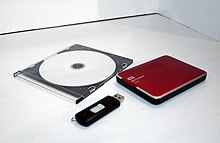
Regardless of the repository model that is used, the data has to be copied onto an archive file information storage medium. The medium used is also referred to as the type of backup destination.
Magnetic tape [edit]
Magnetic tape was for a long fourth dimension the near ordinarily used medium for bulk data storage, backup, archiving, and interchange. It was previously a less expensive option, merely this is no longer the case for smaller amounts of data.[21] Tape is a sequential admission medium, and then the charge per unit of continuously writing or reading information can be very fast. While record media itself has a depression price per infinite, record drives are typically dozens of times as expensive as hard deejay drives and optical drives.
Many tape formats have been proprietary or specific to sure markets like mainframes or a item brand of personal estimator. By 2014 LTO had become the chief record technology.[22] The other remaining viable "super" format is the IBM 3592 (too referred to every bit the TS11xx series). The Oracle StorageTek T10000 was discontinued in 2016.[23]
Hard disk [edit]
The employ of difficult deejay storage has increased over fourth dimension equally information technology has become progressively cheaper. Hard disks are usually easy to use, widely available, and can be accessed apace.[22] Withal, hard disk backups are close-tolerance mechanical devices and may be more easily damaged than tapes, peculiarly while being transported.[24] In the mid-2000s, several drive manufacturers began to produce portable drives employing ramp loading and accelerometer technology (sometimes termed a "shock sensor"),[25] [26] and by 2010 the industry average in drop tests for drives with that technology showed drives remaining intact and working after a 36-inch non-operating driblet onto industrial carpeting.[27] Some manufacturers also offer 'ruggedized' portable difficult drives, which include a shock-absorbing case around the hard disk drive, and claim a range of college drop specifications.[27] [28] [29] Over a menses of years the stability of hard disk backups is shorter than that of record backups.[23] [30] [24]
External hard disks can exist connected via local interfaces similar SCSI, USB, FireWire, or eSATA, or via longer-altitude technologies like Ethernet, iSCSI, or Fibre Channel. Some disk-based backup systems, via Virtual Tape Libraries or otherwise, support data deduplication, which can reduce the amount of deejay storage capacity consumed by daily and weekly backup information.[31] [32] [33]
Optical storage [edit]
Optical storage uses lasers to store and remember data. Recordable CDs, DVDs, and Blu-ray Discs are unremarkably used with personal computers and are generally cheap. In the past, the capacities and speeds of these discs have been lower than hard disks or tapes, although advances in optical media are slowly shrinking that gap.[34] [35]
Potential hereafter data losses caused past gradual media degradation can be predicted by measuring the charge per unit of correctable small-scale data errors, of which consecutively too many increment the risk of uncorrectable sectors. Support for fault scanning varies amongst optical drive vendors.[36]
Many optical disc formats are WORM type, which makes them useful for archival purposes since the information cannot exist changed. Moreover, optical discs are not vulnerable to caput crashes, magnetism, imminent h2o ingress or ability surges, and a error of the drive typically just halts the spinning.
Optical media is modular; the storage controller is external and non tied to media itself like with hard drives or flash storage (flash memory controller), assuasive it to exist removed and accessed through a unlike drive. However, recordable media may dethrone before under long-term exposure to light.[37]
The lack of internal components and magnetism makes optical media unaffected past single event furnishings from ionizing radiation that can exist acquired past environmental disasters like a nuclear meltdown or solar tempest.
Some optical storage systems permit for cataloged data backups without human contact with the discs, allowing for longer data integrity. A French study in 2008 indicated that the lifespan of typically-sold CD-Rs was two–10 years,[38] only one manufacturer later estimated the longevity of its CD-Rs with a gold-sputtered layer to be as loftier every bit 100 years.[39] Sony's proprietary Optical Disc Annal[22] tin can in 2016 reach a read rate of 250MB/s.[40]
Solid-land drive (SSD) [edit]
Solid-land drives (SSDs) use integrated circuit assemblies to store data. Flash memory, thumb drives, USB flash drives, CompactFlash, SmartMedia, Memory Sticks, and Secure Digital card devices are relatively expensive for their depression capacity, but convenient for bankroll up relatively depression information volumes. A solid-state drive does not incorporate any movable parts, making it less susceptible to concrete impairment, and tin can take huge throughput of around 500 Mbit/s up to 6 Gbit/southward. Available SSDs have become more capacious and cheaper.[41] [28] Wink memory backups are stable for fewer years than hard disk drive backups.[23]
Remote backup service [edit]
Remote backup services or cloud backups involve service providers storing information offsite. This has been used to protect confronting events such as fires, floods, or earthquakes which could destroy locally stored backups.[42] Cloud-based backup (through services like or like to Google Drive, and Microsoft OneDrive) provides a layer of data protection.[24] However, the users must trust the provider to maintain the privacy and integrity of their information, with confidentiality enhanced by the use of encryption. Because speed and availability are express by a user's online connection,[24] users with large amounts of data may need to utilize cloud seeding and big-calibration recovery.
Management [edit]
Diverse methods can be used to manage backup media, striking a balance betwixt accessibility, security and cost. These media management methods are not mutually sectional and are frequently combined to run across the user's needs. Using on-line disks for staging information before it is sent to a near-line record library is a common example.[43] [44]
Online [edit]
Online backup storage is typically the most accessible blazon of data storage, and can begin a restore in milliseconds. An internal hard disk or a disk assortment (mayhap connected to SAN) is an case of an online fill-in. This type of storage is convenient and speedy, but is vulnerable to being deleted or overwritten, either past accident, by malevolent action, or in the wake of a data-deleting virus payload.
Nearline [edit]
Nearline storage is typically less accessible and less expensive than online storage, but still useful for backup data storage. A mechanical device is usually used to motion media units from storage into a bulldoze where the data tin can exist read or written. Mostly it has condom backdrop similar to on-line storage. An case is a tape library with restore times ranging from seconds to a few minutes.
Off-line [edit]
Off-line storage requires some directly activeness to provide access to the storage media: for example, inserting a tape into a record bulldoze or plugging in a cable. Because the data is non accessible via any reckoner except during limited periods in which they are written or read back, they are largely immune to on-line backup failure modes. Admission fourth dimension varies depending on whether the media are on-site or off-site.
Off-site data protection [edit]
Backup media may be sent to an off-site vault to protect against a disaster or other site-specific problem. The vault can exist as elementary equally a organisation administrator'due south home office or as sophisticated as a disaster-hardened, temperature-controlled, high-security bunker with facilities for fill-in media storage. A data replica tin can be off-site but as well on-line (eastward.chiliad., an off-site RAID mirror). Such a replica has adequately limited value equally a backup.
Backup site [edit]
A backup site or disaster recovery center is used to store data that tin can enable estimator systems and networks to be restored and properly configure in the event of a disaster. Some organisations have their own information recovery centres, while others contract this out to a third-political party. Due to high costs, backing up is rarely considered the preferred method of moving data to a DR site. A more typical style would exist remote disk mirroring, which keeps the DR information as upward to date every bit possible.
Pick and extraction of data [edit]
A fill-in operation starts with selecting and extracting coherent units of data. Most data on modern computer systems is stored in discrete units, known as files. These files are organized into filesystems. Deciding what to back up at any given time involves tradeoffs. Past backing upward too much redundant data, the information repository will fill up up also quickly. Bankroll upwards an insufficient amount of information tin eventually pb to the loss of critical information.[45]
Files [edit]
- Copying files : Making copies of files is the simplest and most common mode to perform a backup. A means to perform this bones part is included in all backup software and all operating systems.
- Partial file copying: A backup may include only the blocks or bytes inside a file that take changed in a given period of time. This can substantially reduce needed storage infinite, just requires higher sophistication to reconstruct files in a restore situation. Some implementations require integration with the source file system.
- Deleted files : To prevent the unintentional restoration of files that take been intentionally deleted, a record of the deletion must exist kept.
- Versioning of files : Near backup applications, other than those that practise merely full only/organisation imaging, also back up files that have been modified since the last backup. "That way, you can retrieve many different versions of a given file, and if yous delete it on your hard disk drive, you can still notice it in your [information repository] archive."[4]
Filesystems [edit]
- Filesystem dump: A copy of the whole filesystem in cake-level can be made. This is also known equally a "raw partitioning backup" and is related to deejay imaging. The process normally involves unmounting the filesystem and running a programme like dd (Unix).[46] Because the deejay is read sequentially and with large buffers, this blazon of backup can exist faster than reading every file normally, especially when the filesystem contains many small files, is highly fragmented, or is nearly full. But because this method also reads the free deejay blocks that contain no useful data, this method can also be slower than conventional reading, especially when the filesystem is nearly empty. Some filesystems, such every bit XFS, provide a "dump" utility that reads the disk sequentially for high performance while skipping unused sections. The corresponding restore utility can selectively restore private files or the entire volume at the operator'southward pick.[47]
- Identification of changes: Some filesystems take an archive scrap for each file that says it was recently inverse. Some backup software looks at the date of the file and compares it with the concluding backup to determine whether the file was changed.
- Versioning file system : A versioning filesystem tracks all changes to a file. The NILFS versioning filesystem for Linux is an example.[48]
Live data [edit]
Files that are actively being updated nowadays a challenge to support. 1 manner to back upward live data is to temporarily quiesce them (due east.g., close all files), take a "snapshot", and then resume live operations. At this point the snapshot tin be backed up through normal methods.[49] A snapshot is an instantaneous function of some filesystems that presents a copy of the filesystem as if information technology were frozen at a specific indicate in time, ofttimes by a copy-on-write mechanism. Snapshotting a file while it is being changed results in a corrupted file that is unusable. This is also the case across interrelated files, as may be found in a conventional database or in applications such as Microsoft Exchange Server.[15] The term fuzzy backup can be used to depict a backup of live data that looks similar it ran correctly, but does not correspond the country of the data at a single point in fourth dimension.[l]
Backup options for data files that cannot be or are not quiesced include:[51]
- Open file fill-in: Many backup software applications undertake to back up open files in an internally consistent state.[52] Some applications only bank check whether open files are in apply and endeavor over again afterwards.[49] Other applications exclude open files that are updated very oftentimes.[53] Some depression-availability interactive applications can be backed up via natural/induced pausing.
- Interrelated database files backup: Some interrelated database file systems offer a means to generate a "hot backup"[54] of the database while it is online and usable. This may include a snapshot of the data files plus a snapshotted log of changes fabricated while the backup is running. Upon a restore, the changes in the log files are applied to bring the copy of the database up to the point in time at which the initial fill-in concluded.[55] Other low-availability interactive applications tin be backed up via coordinated snapshots. Nonetheless, genuinely-high-availability interactive applications tin exist only exist backed up via Continuous Data Protection.
Metadata [edit]
Non all data stored on the figurer is stored in files. Accurately recovering a complete arrangement from scratch requires keeping rails of this not-file data too.[56]
- Organization clarification: Arrangement specifications are needed to procure an verbal replacement later a disaster.
- Boot sector : The boot sector tin can sometimes be recreated more hands than saving information technology. It usually isn't a normal file and the system won't boot without it.
- Partition layout: The layout of the original disk, as well every bit partition tables and filesystem settings, is needed to properly recreate the original system.
- File metadata : Each file'southward permissions, owner, group, ACLs, and any other metadata need to exist backed up for a restore to properly recreate the original surround.
- System metadata: Dissimilar operating systems have unlike ways of storing configuration information. Microsoft Windows keeps a registry of system information that is more than difficult to restore than a typical file.
Manipulation of data and dataset optimization [edit]
It is oftentimes useful or required to manipulate the data existence backed up to optimize the backup process. These manipulations can improve backup speed, restore speed, data security, media usage and/or reduced bandwidth requirements.
Automated data grooming [edit]
Out-of-date information tin be automatically deleted, but for personal backup applications—as opposed to enterprise client-server backup applications where automated data "training" can be customized—the deletion[note ii] [57] [58] can at most[59] be globally delayed or exist disabled.[threescore]
Compression [edit]
Diverse schemes tin be employed to compress the size of the source data to be stored so that it uses less storage space. Compression is often a built-in feature of tape drive hardware.[61]
Deduplication [edit]
Redundancy due to bankroll upwards similarly configured workstations can be reduced, thus storing just one copy. This technique can exist applied at the file or raw block level. This potentially large reduction[61] is chosen deduplication. It can occur on a server earlier any information moves to backup media, sometimes referred to as source/client side deduplication. This arroyo also reduces bandwidth required to transport backup data to its target media. The procedure can also occur at the target storage device, sometimes referred to equally inline or back-finish deduplication.
Duplication [edit]
Sometimes backups are duplicated to a 2d set of storage media. This can be done to rearrange the archive files to optimize restore speed, or to have a 2nd re-create at a different location or on a different storage medium—as in the disk-to-disk-to-record adequacy of Enterprise client-server backup.
If fill-in media is unavailable, duplicates on the same device may allow merging files' intact parts using a byte editor in case of data corruption.
Encryption [edit]
High-capacity removable storage media such as fill-in tapes present a data security risk if they are lost or stolen.[62] Encrypting the data on these media can mitigate this problem, however encryption is a CPU intensive process that can slow down backup speeds, and the security of the encrypted backups is only as effective as the security of the key management policy.[61]
Multiplexing [edit]
When there are many more computers to be backed up than in that location are destination storage devices, the ability to apply a single storage device with several simultaneous backups tin can exist useful.[63] Even so cramming the scheduled fill-in window via "multiplexed fill-in" is only used for tape destinations.[63]
Refactoring [edit]
The procedure of rearranging the sets of backups in an annal file is known every bit refactoring. For example, if a backup system uses a single record each day to store the incremental backups for all the protected computers, restoring one of the computers could crave many tapes. Refactoring could exist used to consolidate all the backups for a single computer onto a single tape, creating a "synthetic full backup". This is especially useful for backup systems that do incrementals forever style backups.
Staging [edit]
Sometimes backups are copied to a staging disk before existence copied to tape.[63] This procedure is sometimes referred to as D2D2T, an acronym for Disk-to-disk-to-tape. It can be useful if there is a problem matching the speed of the final destination device with the source device, as is frequently faced in network-based fill-in systems. It can as well serve as a centralized location for applying other information manipulation techniques.
Objectives [edit]
- Recovery point objective (RPO) : The point in time that the restarted infrastructure will reflect, expressed as "the maximum targeted period in which data (transactions) might be lost from an Information technology service due to a major incident". Essentially, this is the roll-back that will be experienced as a result of the recovery. The almost desirable RPO would be the point but prior to the information loss consequence. Making a more recent recovery signal achievable requires increasing the frequency of synchronization between the source data and the backup repository.[64]
- Recovery fourth dimension objective (RTO) : The corporeality of time elapsed between disaster and restoration of business organisation functions.[65]
- Data security : In addition to preserving access to information for its owners, data must be restricted from unauthorized access. Backups must be performed in a manner that does not compromise the original owner's undertaking. This can be achieved with data encryption and proper media handling policies.[66]
- Data retention catamenia : Regulations and policy can lead to situations where backups are expected to exist retained for a particular menstruation, just not any farther. Retaining backups afterwards this menstruation can atomic number 82 to unwanted liability and sub-optimal utilise of storage media.[66]
- Checksum or hash office validation : Applications that back up to tape archive files need this option to verify that the information was accurately copied.[67]
- Backup process monitoring : Enterprise client-server backup applications demand a user interface that allows administrators to monitor the backup process, and proves compliance to regulatory bodies outside the organization; for example, an insurance company in the U.s. might be required under HIPAA to demonstrate that its client data encounter records retentiveness requirements.[68]
- User-initiated backups and restores : To avoid or recover from minor disasters, such as inadvertently deleting or overwriting the "good" versions of one or more files, the computer user—rather than an administrator—may initiate backups and restores (from not necessarily the most-contempo backup) of files or folders.
Run into likewise [edit]
- About backup
- Backup software & services
- List of backup software
- List of online fill-in services
- Glossary of backup terms
- Virtual backup apparatus
- Related topics
- Data consistency
- Data degradation
- Data portability
- Data proliferation
- Database dump
- Digital preservation
- Disaster recovery and business continuity auditing
- Swiss cheese model
Notes [edit]
- ^ In contrast to everyday utilise of the term "annal", the data stored in an "archive file" is not necessarily old or of historical interest.
- ^ Some backup applications—notably rsync and CrashPlan—term removing backup data "pruning" instead of "grooming".
References [edit]
- ^ "back•up". The American Heritage Dictionary of the English Language. Houghton Mifflin Harcourt. 2018. Retrieved nine May 2018.
- ^ S. Nelson (2011). "Chapter 1: Introduction to Backup and Recovery". Pro Information Fill-in and Recovery. Apress. pp. 1–xvi. ISBN978-ane-4302-2663-5 . Retrieved viii May 2018.
- ^ Heiberger, E.L.; Koop, Yard. (2003). "Chapter one: What's a Disaster Without a Recovery?". The Backup Book: Disaster Recovery from Desktop to Data Center. Network Frontiers. pp. 1–14. ISBN0-9729039-0-9.
- ^ a b c Joe Kissell (2007). Take Control of Mac OS 10 Backups (PDF) (Version two.0 ed.). Ithaca, NY: TidBITS Electronic Publishing. pp. 18–xx ("The Annal", meaning information repository, including versioning), 24 (customer-server), 82–83 (archive file), 112–114 (Off-site storage fill-in rotation scheme), 126–141 (former Hindsight terminology and GUI—notwithstanding used in Windows variant), 165 (customer-server), 128 (subvolume—later renamed Favorite Folder in Macintosh variant). ISBN978-0-9759503-0-two . Retrieved 17 May 2019.
- ^ Terry Sullivan (11 January 2018). "A Beginner's Guide to Backing Up Photos". The New York Times.
a hard drive ... an established company ... alleged bankruptcy ... where many ... had ...
- ^ McMahon, Mary (1 April 2019). "What Is an Information Repository?". wiseGEEK. Theorize Corporation. Retrieved 8 May 2019.
In the sense of an approach to data direction, an information repository is a secondary storage space for data.
- ^ "The 3-ii-1 Backup Rule – Data Protection Strategy". Official NAKIVO Web log. 13 Nov 2017.
- ^ a b c d e Mayer, Alex (6 November 2017). "Backup Types Explained: Full, Incremental, Differential, Synthetic, and Forever-Incremental". Nakivo Blog. Nakivo. Full Fill-in, Incremental Backup, Differential Backup, Mirror Fill-in, Reverse Incremental Backup, Continuous Data Protection (CDP), Synthetic Full Backup, Forever-Incremental Fill-in. Retrieved 17 May 2019.
- ^ "Five key questions to ask about your backup solution". sysgen.ca. 23 March 2014. Does your company have a low tolerance to longer "data access outages" and/or would y'all like to minimize the time your company may be without its information?. Archived from the original on four March 2016. Retrieved 23 September 2015.
- ^ Reed, Jessie (27 February 2018). "What Is Incremental Fill-in?". Nakivo Web log. Nakivo. Opposite incremental, Multilevel incremental, Block-level. Retrieved 17 May 2019.
- ^ "Incremental Fill-in". Tech-FAQ. Independent Media. thirteen June 2005. Archived from the original on 21 June 2016. Retrieved 10 March 2006.
- ^ "Forever incremental backup in Vinchin Fill-in & Recovery". Vinchin Web log. Vinchin. 26 Baronial 2021.
- ^ Pond, James (31 August 2013). "How Time Motorcar Works its Magic". Apple OSX and Fourth dimension Machine Tips. baligu.com. File Organisation Event Store,Hard Links. Retrieved 19 May 2019.
- ^ a b Behzad Behtash (6 May 2010). "Why Continuous Data Protection's Getting More than Applied". Disaster recovery/business continuity. InformationWeek. Retrieved 12 Nov 2011.
A true CDP arroyo should capture all data writes, thus continuously bankroll up data and eliminating backup windows.... CDP is the gold standard—the most comprehensive and advanced data protection. But "near CDP" technologies can deliver enough protection for many companies with less complication and cost. For example, snapshots tin provide a reasonable most-CDP-level of protection for file shares, letting users directly admission data on the file share at regular intervals--say, every one-half-hr or 15 minutes. That's certainly a higher level of protection than tape-based or disk-based nightly backups and may be all you need.
- ^ a b "Continuous data protection (CDP) explained: Truthful CDP vs near-CDP". ComputerWeekly.com. TechTarget. July 2010. Retrieved 22 June 2019.
... copies data from a source to a target. Truthful CDP does this every time a change is made, while and so-called near-CDP does this at pre-set fourth dimension intervals. Near-CDP is effectively the same as snapshotting....True CDP systems record every write and copy them to the target where all changes are stored in a log. [new paragraph] By contrast, virtually-CDP/snapshot systems copy files in a straightforward manner simply require applications to be quiesced and made ready for fill-in, either via the application'due south backup mode or using, for example, Microsoft's Volume Shadow Copy Services (VSS).
- ^ Swimming, James (31 August 2013). "How Time Machine Works its Magic". Apple OSX and Time Automobile Tips. Baligu.com (every bit mirrored after James Swimming died in 2013). Retrieved ten July 2019.
The File System Consequence Store is a hidden log that OSX keeps on each HFS+ formatted disk/sectionalization of changes made to the data on it. It doesn't list every file that's changed, but each directory (binder) that's had anything changed within it.
- ^ de Guise, P. (2009). Enterprise Systems Fill-in and Recovery: A Corporate Insurance Policy. CRC Press. pp. 285–287. ISBN978-i-4200-7639-4.
- ^ Wu, Victor (iv March 2017). "EMC RecoverPoint for Virtual Machine Overview". Victor Virtual. WuChiKin. Retrieved 22 June 2019.
The splitter splits out the Write IOs to the VMDK/RDM of a VM and sends a copy to the product VMDK and besides to the RecoverPoint for VMs cluster.
- ^ "Zerto or Veeam?". RES-Q Services. March 2017. Retrieved 7 July 2019.
Zerto doesn't use snapshot technology like Veeam. Instead, Zerto deploys small virtual machines on its physical hosts. These Zerto VMs capture the information as it is written to the host and and so transport a re-create of that data to the replication site.....Nonetheless, Veeam has the advantage of existence able to more efficiently capture and store data for long-term retention needs. There is also a significant pricing divergence, with Veeam being cheaper than Zerto.
- ^ Gardner, Steve (9 December 2004). "Disk to Disk Backup versus Tape – War or Truce?". Engenio. Peaceful coexistence. Archived from the original on 7 February 2005. Retrieved 26 May 2019.
- ^ a b c "Digital Data Storage Outlook 2017" (PDF). Spectra. Spectra Logic. 2017. p. vii(Solid-State), 10(Magnetic Disk), xiv(Tape), 17(Optical). Retrieved eleven July 2018.
- ^ a b c Tom Coughlin (29 June 2014). "Keeping Data for a Long Time". Forbes. para. Magnetic Tapes(pop formats, storage life), para. Hd Drives(agile archive), para. Starting time consider wink memory in archiving(... may not take adept media archive life). Retrieved nineteen Apr 2018.
- ^ a b c d Jacobi, John L. (29 February 2016). "Hard-core data preservation: The best media and methods for archiving your information". PC Globe. sec. External Hard Drives(on the shelf, magnetic properties, mechanical stresses, vulnerable to shocks), Tape, Online storage. Retrieved 19 April 2018.
- ^ "Ramp Load/Unload Technology in Hard Disk Drives" (PDF). HGST. Western Digital. Nov 2007. p. three(sec. Enhanced Daze Tolerance). Retrieved 29 June 2018.
- ^ "Toshiba Portable Hard Drive (Canvio® 3.0)". Toshiba Data Dynamics Singapore. Toshiba Information Dynamics Pte Ltd. 2018. sec. Overview(Internal shock sensor and ramp loading engineering). Retrieved sixteen June 2018.
- ^ a b "Iomega Drop Guard ™ Technology" (PDF). Hard Drive Storage Solutions. Iomega Corp. 20 September 2010. pp. 2(What is Drib Stupor Technology?, What is Drop Baby-sit Technology? (... features special internal cushioning .... 40% above the industry boilerplate)), iii(*NOTE). Retrieved 12 July 2018.
- ^ a b John Burek (15 May 2018). "The Best Rugged Hard Drives and SSDs". PC Magazine. Ziff Davis. What Exactly Makes a Drive Rugged?(When a drive is encased ... you lot're mostly at the mercy of the drive vendor to tell you the rated maximum drop distance for the drive). Retrieved 4 Baronial 2018.
- ^ Justin Krajeski; Kimber Streams (twenty March 2017). "The Best Portable Hard Bulldoze". The New York Times. Archived from the original on 31 March 2017. Retrieved iv August 2018.
- ^ "All-time Long-Term Information Annal Solutions". Iron Mount. Iron Mountain Inc. 2018. sec. More Reliable(average hateful time between failure ... rates, best practise for migrating data). Retrieved nineteen Apr 2018.
- ^ Kissell, Joe (2011). Take Command of Backing Upwardly Your Mac. Ithaca NY: TidBITS Publishing Inc. p. 41(Deduplication). ISBN978-one-61542-394-1 . Retrieved 17 September 2019.
- ^ "Symantec Shows Backup Exec a Petty Dedupe Honey; Lays out Source Side Deduplication Roadmap – DCIG". DCIG. Archived from the original on iv March 2016. Retrieved 26 February 2016.
- ^ "Veritas NetBackup™ Deduplication Guide". Veritas. Veritas Technologies LLC. 2016. Retrieved 26 July 2018.
- ^ Due south. Wan; Q. Cao; C. Xie (2014). "Optical storage: An emerging option in long-term digital preservation". Frontiers of Optoelectronics. seven (4): 486–492. doi:10.1007/s12200-014-0442-2. S2CID 60816607.
- ^ Q. Zhang; Z. Xia; Y.-B. Cheng; M. Gu (2018). "High-capacity optical long data memory based on enhanced Young'south modulus in nanoplasmonic hybrid drinking glass composites". Nature Communications. nine (i): 1183. Bibcode:2018NatCo...nine.1183Z. doi:10.1038/s41467-018-03589-y. PMC5864957. PMID 29568055.
- ^ Bärwaldt, Erik (2014). "Full Control » Linux Mag". Linux Mag.
- ^ "5. Conditions That Affect CDs and DVDs • CLIR". CLIR.
- ^ Gérard Poirier; Foued Berahou (3 March 2008). "Journal de 20 Heures". Institut national de l'audiovisuel. approximately infinitesimal 30 of the Tv news broadcast. Retrieved 3 March 2008.
- ^ "Archival Gold CD-R "300 Twelvemonth Disc" Binder of 10 Discs with Scratch Armor Surface". Delkin Devices. Delkin Devices Inc. Archived from the original on 27 September 2013.
- ^ "Optical Disc Archive Generation two" (PDF). Optical Disc Archive. Sony. April 2016. p. 12(World'south First 8-Aqueduct Optical Bulldoze Unit of measurement). Retrieved 15 August 2019.
- ^ R. Micheloni; P. Olivo (2017). "Solid-State Drives (SSDs)". Proceedings of the IEEE. 105 (ix): 1586–88. doi:x.1109/JPROC.2017.2727228.
- ^ "Remote Backup". EMC Glossary. Dell, Inc. Retrieved eight May 2018.
Constructive remote backup requires that product data be regularly backed upwards to a location far enough abroad from the principal location and then that both locations would not exist affected by the aforementioned disruptive event.
- ^ Stackpole, B.; Hanrion, P. (2007). Software Deployment, Updating, and Patching. CRC Press. pp. 164–165. ISBN978-one-4200-1329-0 . Retrieved 8 May 2018.
- ^ Gnanasundaram, S.; Shrivastava, A., eds. (2012). Information Storage and Management: Storing, Managing, and Protecting Digital Information in Classic, Virtualized, and Deject Environments. John Wiley and Sons. p. 255. ISBN978-i-118-23696-3 . Retrieved eight May 2018.
- ^ Lee (25 January 2017). "What to backup – a disquisitional wait at your information". Irontree Blog. Irontree Internet Services CC. Retrieved 8 May 2018.
- ^ Preston, Westward.C. (2007). Backup & Recovery: Inexpensive Backup Solutions for Open Systems. O'Reilly Media, Inc. pp. 111–114. ISBN978-0-596-55504-7 . Retrieved 8 May 2018.
- ^ Preston, W.C. (1999). Unix Backup & Recovery . O'Reilly Media, Inc. pp. 73–91. ISBN978-1-56592-642-4 . Retrieved 8 May 2018.
- ^ "NILFS Dwelling". NILFS Continuous Snapshotting System. NILFS Community. 2019. Retrieved 22 Baronial 2019.
- ^ a b Cougias, D.J.; Heiberger, E.L.; Koop, Thousand. (2003). "Chapter 11: Open file backup for databases". The Backup Volume: Disaster Recovery from Desktop to Data Heart. Network Frontiers. pp. 356–360. ISBN0-9729039-0-9.
- ^ Liotine, M. (2003). Mission-disquisitional Network Planning. Artech House. p. 244. ISBN978-i-58053-559-v . Retrieved 8 May 2018.
- ^ de Guise, P. (2009). Enterprise Systems Backup and Recovery: A Corporate Insurance Policy. CRC Printing. pp. fifty–54. ISBN978-1-4200-7639-4.
- ^ "Open File Backup Software for Windows". Handy Fill-in. Novosoft LLC. eight November 2018. Retrieved 29 November 2018.
- ^ Reitshamer, Stefan (5 July 2017). "Troubleshooting backing up open/locked files on Windows". Arq Blog. Haystack Software. Stefan Reitshamer is the master developer of Arq. Retrieved 29 November 2018.
- ^ Dominate, Nina (10 December 1997). "Oracle Tips Session #three: Oracle Backups". www.wisc.edu. University of Wisconsin. Archived from the original on 2 March 2007. Retrieved one December 2018.
- ^ "What is Annal-LOG and NO-Archive-LOG mode in Oracle and the advantages & disadvantages of these modes?". Arcserve Fill-in. Arcserve. 27 September 2018. Retrieved 29 November 2018.
- ^ Grešovnik, Igor (Apr 2016). "Preparation of Bootable Media and Images". Archived from the original on 25 April 2016. Retrieved 21 April 2016.
- ^ "rsync(1) - Linux man page". linux.dice.cyberspace.
- ^ "Archive maintenance". Code42 Back up. 22 July 2015.
- ^ Pond, James (2 June 2012). "12. Should I delete sometime backups? If so, How?". Time Machine. baligu.com. Green box, Grayness box. Retrieved 21 June 2019.
- ^ Kissell, Joe (12 March 2019). "The All-time Online Deject Backup Service". wirecutter. The New York Times. Next, there's file retentiveness. Retrieved 21 June 2019.
- ^ a b c D. Scarlet (2015). Securing SQL Server: Protecting Your Database from Attackers. Syngress. pp. 306–308. ISBN978-0-12-801375-5 . Retrieved 8 May 2018.
- ^ Backups tapes a backdoor for identity thieves Archived 5 Apr 2016 at the Wayback Machine (28 April 2004). Retrieved ten March 2007
- ^ a b c Preston, W.C. (2007). Fill-in & Recovery: Inexpensive Backup Solutions for Open Systems. O'Reilly Media, Inc. pp. 219–220. ISBN978-0-596-55504-7 . Retrieved 8 May 2018.
- ^ "Recovery Point Objective (Definition)". ARL Risky Thinking. Albion Research Ltd. 2007. Retrieved four August 2019.
- ^ "Recovery Fourth dimension Objective (Definition)". ARL Risky Thinking. Albion Inquiry Ltd. 2007. Retrieved iv August 2019.
- ^ a b Little, D.B. (2003). "Affiliate 2: Concern Requirements of Backup Systems". Implementing Backup and Recovery: The Readiness Guide for the Enterprise. John Wiley and Sons. pp. 17–30. ISBN978-0-471-48081-v . Retrieved 8 May 2018.
- ^ "How do the "verify" and "write checksums to media" processes piece of work and why are they necessary?". Veritas Support. Veritas.com. 15 October 2015. Write checksums to media. Retrieved 16 September 2019.
- ^ HIPAA Informational Archived 11 April 2007 at the Wayback Car. Retrieved 10 March 2007
External links [edit]
Source: https://en.wikipedia.org/wiki/Backup
Posted by: scottsturaccou.blogspot.com
0 Response to "How To Take Backup Of Windows Server 2003"
Post a Comment