

How To Enable Wmi Windows 10
In this postal service I show y'all how you tin enable Remote Desktop on Windows 10 via Grouping Policy, PowerShell, WMI, or psexec considering even the geekiest CLI geek sometimes needs to RDP into a remote Windows machine.
- Author
- Contempo Posts

Michael Pietroforte is the founder and editor in chief of 4sysops. He has more than 35 years of experience in IT management and system administration.
You probably know yous can enable Remote Desktop in the Windows 10 Control Console'southward Arrangement app. That's quick to practice if the figurer is on your desk. However, if you want to access a remote machine and Remote Desktop is disabled for security reasons in your system, you lot have to enable Remote Desktop access remotely.

Allow remote connections in the Windows ten Control Panel
Let Remote Desktop via Group Policy ^
The easiest mode certainly is to enable RDP admission via Group Policy:Let users to connect remotely using Remote Desktop Services
You tin find the policy here:
Reckoner Configuration > Administrative Templates > Windows Components >Remote Desktop Services > Remote Desktop Session Host > Connections.
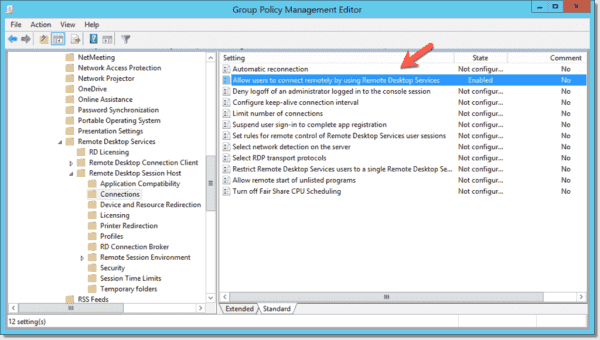
Permit users to connect remotely by using Remote Desktop Services
You volition as well have to let RDP in the Windows Firewall on the remote Windows 10 computer:
Computer Configuration > Policies > Authoritative Templates > Network > Network Connections > Windows Firewall > Domain Profile

Allow inbound Remote Desktop connections via Group Policy
The only trouble is that Group Policy is sluggish, and if you want to log in quickly to a remote machine, it is often non an selection. By contrast, on a PowerShell panel, y'all can essentially go the job done with a single command.
Enable Remote Desktop via PowerShell ^
However, there is a grab—actually, ii. Windows Firewall might get in your manner, and if PowerShell remoting is non enabled on the machine, things tin can get a bit tricky. I know of two methods to enable Remote Desktop remotely via PowerShell. Which method yous apply mostly depends on your Windows Firewall configuration.
Let'due south assume first that PowerShell remoting is enabled on the remote automobile. If and then, you can but enable Remote Desktop by modifying a registry primal on the remote machine:
Invoke-Command -Computername <computer name> -ScriptBlock {Ready-ItemProperty -Path "HKLM:\Organization\CurrentControlSet\Control\Concluding Server" -Name "fDenyTSConnections" –Value 0 } We are using Invoke-Command to execute the Set-ItemProperty remotely, which changes the value fDenyTSConnections to 0.
Most probable, Windows Firewall blocks RDP on the remote machine. To open the Remote Desktop port, you lot can apply this PowerShell control:
Invoke-Command -Computername <computer name> -ScriptBlock {Enable-NetFirewallRule -DisplayGroup "Remote Desktop"} Nosotros are using PowerShell remoting once more to execute Enable-NetFirewallRule remotely.
Enable Remote Desktop via WMI ^
If PowerShell remoting is not enabled on the remote machine, you can yet apply PowerShell via WMI for the job. This can be useful if you need to enable RDP on multiple machines or if this task is part of a larger automation problem and your organization'south security guidelines don't allow PowerShell remoting. Sitaram wrote a PowerShell script that uses the Get-WmiObject cmdlet. This allows you to manage computers remotely without PowerShell remoting.
I removed the role of the script that first checks via Exam-Connexion if the calculator is online considering this would require an additional firewall setting to brand the script piece of work.
[cmdletbinding()] param( [parameter(ValueFromPipeline=$truthful,ValueFromPipelineByPropertyName=$truthful)] [cord[]]$ComputerName = $env:computername, [ValidateScript({Test-Path $_})] [string]$OutFolder = "c:\" ) begin { $SuccessComps = Bring together-Path $OutFolder "Successcomps.txt" $FailedComps = Join-Path $OutFolder "FailedComps.txt" } process { foreach($Reckoner in $ComputerName) { endeavor { $RDP = Get-WmiObject -Form Win32_TerminalServiceSetting ` -Namespace root\CIMV2\TerminalServices ` -Calculator $Computer ` -Hallmark vi ` -ErrorAction Stop } catch { Write-Host "$Figurer : WMIQueryFailed" "$Reckoner : WMIQueryFailed" | Out-File -FilePath $FailedComps -Suspend proceed } if($RDP.AllowTSConnections -eq 1) { Write-Host "$Computer : RDP Already Enabled" "$Computer : RDP Already Enabled" | Out-File -FilePath $SuccessComps -Suspend continue } else { try { $result = $RDP.SetAllowTsConnections(one,1) if($issue.ReturnValue -eq 0) { Write-Host "$Estimator : Enabled RDP Successfully" "$Computer : RDP Enabled Successfully" | Out-File -FilePath $SuccessComps -Suspend } else { Write-Host "$Computer : Failed to enabled RDP" "$Calculator : Failed to enable RDP" | Out-File -FilePath $FailedComps -Append } } grab { Write-Host "$calculator : Failed to enabled RDP" "$Calculator : Failed to enable RDP" | Out-File -FilePath $FailedComps -Append } } } } end {} To understand how the script works, please read Sitaram'southward article. To use the script, you lot just have to save it to a file (Enable-RDPAccess.ps1) and and then run this control:
.\Enable-RDPAccess.ps1 -ComputerName <estimator proper name>

Enable RDP via WMI
If you lot want to enable RDP on multiple Windows 10 computers, you tin can save the computer names in a text file and so employ Get-Content to piping the estimator names to Enable-RDPAccess.ps1:
Get-Content <path to text file> | Enable-RDPAccess.ps1
Theoretically, you probably can also configure the Windows Firewall to permit the RDP connection withGet-WmiObject. However, I couldn't find the corresponding course. If you know more, please post a comment beneath.
Nonetheless, I know some other way to configure the firewall via WMI, and that is with the wmic command:
wmic /node:<estimator proper name> process call create "cmd.exe /c netsh firewall fix service RemoteDesktop enable"
Of course, y'all can too enable Remote Desktop with wmic:
wmic /node:<calculator name> process call create 'cmd.exe /c reg add together "HKEY_LOCAL_MACHINE\Organisation\CurrentControlSet\Command\Last Server" /v fDenyTSConnections /t REG_DWORD /d 0 /f'

Remotely enable RDP on Windows x with wmic
Annotation that you have to configure the Windows Firewall of the remote machine to permit WMI admission for the PowerShell script and for wmic to work. You could do this via Group Policy:
Computer Configuration > Policies > Windows Settings > Security Settings > Windows Firewall with Advanced Security.
Right-click Inbound Rules and then add the predefined dominion Windows Management Instrumentation (WMI).
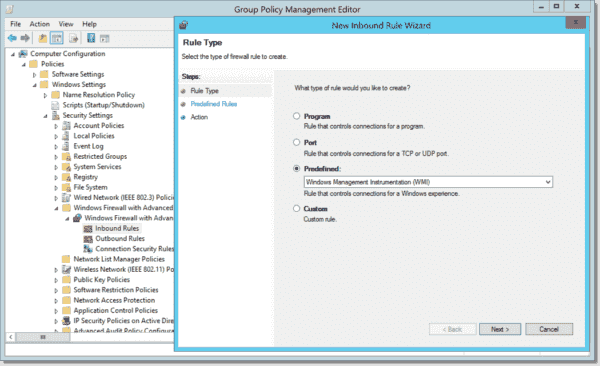
Enable WMI in Windows Firewall via Group Policy
But now nosotros are where we were in the starting time. We could then just use Group Policy to enable RDP correct abroad. Still, if WMI is already enabled in your firewall for other reasons, using Get-WmiObject is an option.
Besides, if you lot often accept to enable RDP remotely on Windows 10 machines, only your company policy doesn't permit you to work with PowerShell remoting, you could besides consider opening WMI in your firewall permanently. I suppose it is less risky but because WMI is more difficult to apply than PowerShell remoting, and all the script kiddies who downloaded PowerShell scripts to hack into your systems will be in trouble.
Enable RDP via psexec ^
All the same some other option is Microsoft's free tool psexec. Information technology besides doesn't require PowerShell remoting to be enabled. The only downside is that it is not every bit straightforward to apply as Invoke-Control in PowerShell scripts. Psexec requires that Windows Firewall is open up for File and Printer sharing, which is probably more common than open up WMI ports or enabled PowerShell remoting:
Estimator Configuration > Policies > Administrative Templates > Network > Network Connections > Windows Firewall > Domain Profile > Windows Firewall: Allow inbound file and printer sharing exception

Let file and printer sharing in the Windows Firewall
To change the registry to enable RDP with psexec, you lot have to run this command:
psexec.exe \\<computer name> reg add together "HKEY_LOCAL_MACHINE\SYSTEM\CurrentControlSet\Control\Terminal Server" /v fDenyTSConnections /t REG_DWORD /d 0 /f
This command also but sets the registry key that disables Terminal Server access to 0.
To allow RDP connections in the Windows Firewall, you can as well use psexec:
Subscribe to 4sysops newsletter!
psexec.exe \\<computer proper noun> netsh firewall gear up service RemoteDesktop enable

Enable Remote Desktop with psexec
Conclusion ^
If you have to enable Remote Desktop remotely, you take a variety of options. Which i you utilize depends on how speedily you need access and the Windows Firewall configuration on the remote motorcar. If all the firewall ports discussed in this mail are closed, Group Policy is your but option. If someone is close to the reckoner, the person can reboot the machine to apply the GPO. Yes, you tin as well remotely reboot the machine. Simply if you don't accept a organisation management tool with this feature, you besides have to open a couple of firewall ports for a remote reboot.


Source: https://4sysops.com/archives/enable-remote-desktop-remotely-on-windows-10/
Posted by: scottsturaccou.blogspot.com
0 Response to "How To Enable Wmi Windows 10"
Post a Comment